

 Atrás
Atrás 



English selection
Bringing young people back to the cinema and festivals through TikTok

 Jose A. Cano
A little over a month ago, Argentinian film director, Arturo Castro, competed for the Colón de Oro at the Festival de Cine Iberoamericano film festival in Huelva with his film Rinoceronte. After the presentation of his film, and as he was getting ready for an interview with the award’s official media, the reporter let him know that the recording had started and asked: “Nickname?” “Arturito.” “Zodiac sign?” “Leo.” “If you had to choose a film genre for a biopic about your life?” “Musical.” answered Castro amidst laughter. Another question followed: “Who from the festival would you go to a party with?”
In the end, the Colón was awarded to Fernando Guzzoni’s Chilean film – Blanquita. Of course, Castro’s and the other Sección Oficial films had their own press conference, official press release and premier with a more traditional film analysis. Those were questions the filmmaker was answering for their TikTok account, which they also used as an experiment for the Jóvenes Comunicadores de Cine – a project run by a group of young people which basically aims to translate the festival’s ostentation to the Gen-Z language, and to keep the festival “alive” on other social media even after its week-long celebration in mid-November. Such are the initiatives taken to connect the TikTok audience to the cinema.
“The idea was to bring some of the festival’s communications team to those aged between their late teens and early twenties – a part of the population that has stopped going to movie theatres”, explains journalist, critic, and manager of the Cine y Valores section of the Andalusian film competition, Carlos Loureda, to Cine con Ñ. “We, as the film industry, spend our entire lives wondering why people don’t go to the cinema, a question we end up answering ourselves. The idea with this, was that they would respond themselves using their own means of communication. I was looking for a way to spread the information of a traditional film festival in the least traditional way.”
TikTok and the cinema: no spoilers, please
The Huelva film festival is far from being the first festival present on Instagram or TikTok, and in fact, all are present on the former social media. Of all the major Spanish film competitions, San Sebastián, also known as Donosti, is without a doubt the only one present on Gen-Z TikTok. They have 11,000 very active followers thanks to the recent signed collaboration between the Chinese network itself and the Valladolid International Film Festival (Seminci), which only has 22 followers.
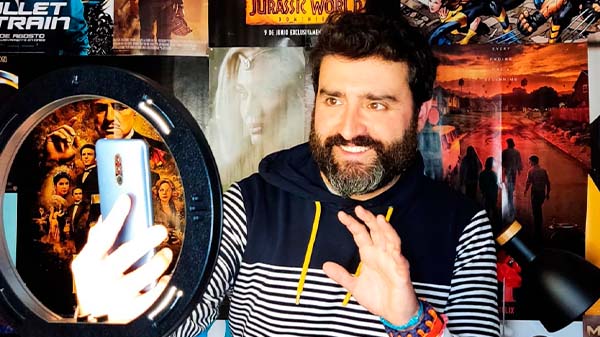
In fact, a space was set up during the last Donosti ceremony just for TikTok, which was organising an event with the Spanish Ministry of Culture and invited several film-industry influencers. This was just like other award ceremonies and similar to the recent Forqué award. Young journalist Diego Merayo, who is a regular on the radio, and contributor to Cadena SER en Valladolid (Spain’s premier radio network), has a channel – Te lo cuento sin spoilers which would be an example of what it looks like to look for the young public where they are, and to adapt to their language. He has not had a problem jumping from YouTube to Instagram, and from there to TikTok, where he has gathered almost 700,000 followers.
Merayo is one of the audio-visual influencers already integrated in the traditional system. He explains that part of his content focuses “on transmitting the experience of what it’s like going to the cinema, which is not the same as staying at home, and because I myself go to the cinema once a week.” He also adds that he does not necessarily believe that TikTok, his favourite social media, brings in the younger generation: “I have followers who may be under 18, but also over 60, so most of all, I would say it opens the door for people who do not consume media in the traditional way.”
In his case, he has proven that the most popular thing to do is “not to retrieve an old classic that young people find impossible to understand, or to talk about Avatar 2, because there are already thousands of accounts already doing it. What works for me is to find a platform’s buried treasure, or a film that was less of a box-office success. Spanish examples include Oriol Paulo’s Contratiempo (2016), or Miguel Ángel Vivas’ Secuestrados (2009). Thrillers work on my account because at the end of the day it’s what I like, and my audience responds to that.”
The main difference with traditional radio journalism, which he combines his social media activity with, is that “the relationship with the audience is much more direct. On social media, and more specifically TikTok, you get messages every day, on every video. There’s no barrier, you can write at any time of the day.”
The star of the Prado Museum and the Cirque du Soleil
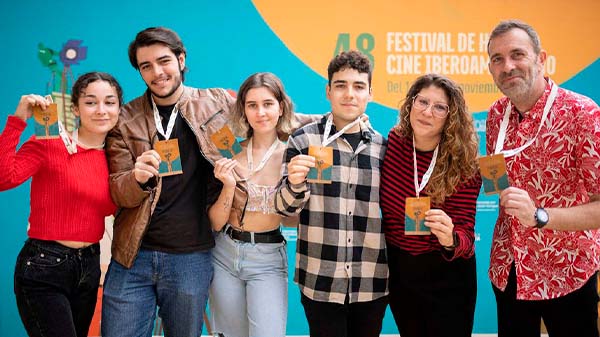
Sofía Torres, one of the participants in the Huelva experiment, explains that the inspiration came from cultural institutions like the Cirque du Soleil or the Prado Museum, more than other film competitions. “After lockdown and during the pandemic, I was one of the first people to find out that the Cirque du Soleil had returned, because they uploaded videos of their rehearsals to their TikTok account. It made me think about how some museums have managed to gain a lot of very young followers with this exact type of content, when they are supposed to be institutions as far removed from these tastes as possible.”
In addition to Torres, the full Jóvenes Comunicadores de Cine’s team includes David Franillo, Laura Liñán, Pedro González and Rosalía Fernández. “At the end of the day, an interview is an interview”, they comment, “the difference may be in the duration and formality of the questions that directors might not be used to asking at festivals. The trick here, is to use the language used by young people on those social media.”
Loureda links the Jóvenes Comunicadores de Cine and the Cine y Valores competition program to bringing Huelva primary school children who, between the pandemic and the ruler of all social media platforms, hadn’t yet set foot inside a cinema until this year. “Some of the children told us they went to the cinema to watch films they had already seen but wanted to see what it was like in a movie theatre. If we want festivals to survive and not die out, we must try things like this. We must look for young people where they are, and not where we wish to find them. Otherwise, in the end, we’ll only read our own work. They’ll listen if they do it themselves, but they wouldn’t listen to us dinosaurs.”
Cover photo: TikTok and San Sebastian film festival creative agreement – San Sebastian Zinemaldia festival


