

 Atrás
Atrás 



English selection
Filmoteca celebrates its 70th anniversary: From two employees working from home to becoming the centre of film heritage

 Jose A. Cano
The Filmoteca Española (Spanish Cinemathèque) was long overdue. Most equivalent European institutions were founded in the 1930s, as an attempt to keep alive the memory of silent films. After becoming out-dated with the arrival of sound, and as the urban legend goes, they were sold at a discounted price and used to make combs. Later, in the 1950s, they focused on saving the old nitrate tapes and turning them into celluloid.
It was during that time, in 1953, that Filmoteca Nacional as it was called back then, came to Spain. It had been pushed by journalist and historian, Carlos Fernández Cuenca, who’s love for cinema and proximity to the Franco regime led to its creation. Without him, “it would still be all talk, and Filmoteca would’ve been founded much later, and even more films would’ve been lost. And that’s the memory and history of a country”, comments Antonio Santamarina, film historian, researcher and manager of the institution between 2002 and 2016.
Santamarina recalls about Filmoteca, that “at the beginning it had two employees, Fernández Cuenca himself and another who also worked part-time at the NO&DO, (a state-controlled series of cinema newsreels produced in Spain from 1943 to 1981), so you can imagine. And for a while, the headquarters was the director’s office in his house”. Unimaginable conditions today, but it remained like that for years. In 1957, when Filmoteca Española entered the International Federation of Film Archives (FIAF), the administrative form stated, “the staff is limited to three people: the director, the secretary and the administrative assistant for motion pictures”.
On February 13 of this year, Filmoteca Española will be celebrating 70 years of history. A lot has changed between 1953 and 2023. The projection of films begun in 1963, and after decades of making their way around different cinemas in Madrid, they were set up at the Cine Doré in 1989, which had since become its symbol for a couple of generations. From hoarding a few titles in precarious conditions and using the house of its wilful and pioneering founder as headquarters, to boasting his own Centro de Conservación y Restauración (CCR) and Centro de Investigación Cinematográfica y Administración.
Currently awaiting a new film law that will make it an Asset of Cultural Interest (Bien de Interés Cultural). The institution itself will be celebrating its anniversary in February with two special showings at the Doré cinema – That Happy Couple (Esa pareja feliz) by Juan Antonio Bardem and Luis García Berlanga, 1951, as well as El cálido verano del señor Rodríguez by Pedro Lazaga, 1965. In addition, there will be a preview of the film restoration of Segundo López, Urban Adventurer, directed by Ana Mariscal in 1953, the year Filmoteca was born.
The milestone of getting set up in the Doré
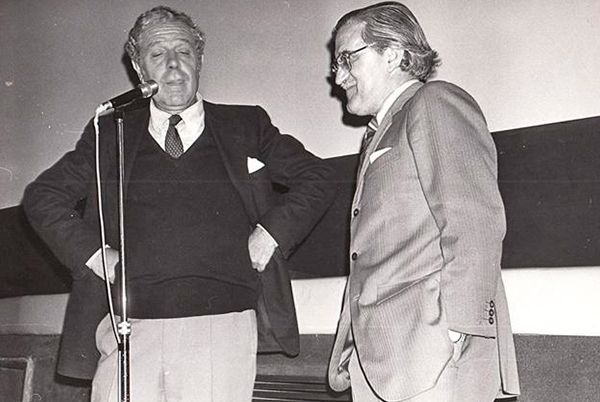
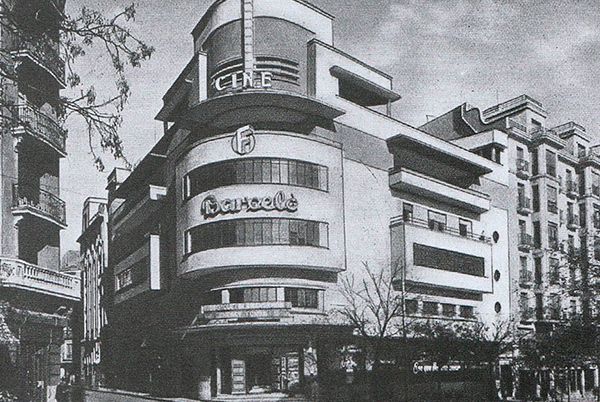
Antonio Santamarina reflects on the importance of Fernández Cuenca’s handover, the legendary Florentino Soria, who was a director, screenwriter and even an actor before joining Filmoteca in 1970. With him, film projections were confirmed as part of Filmoteca’s purpose, although they went back and forth between the Salón de Actos del Instituto Nacional de Previsión and the los Cines Barceló and California. But above all, as the historian points out “a team was created”. Important figures for the institution joined in the following decades, such as future director, José María Prado, curators and film restorers Ramón Rubio and Alfonso del Amo, or producer Catherine Gautier.
Back then, the position of president of the Filmoteca Española existed. It was first held by Carlos Fernández Cuenca himself, until his death in 1977, and later by Luis García Berlanga, between 1978 and 1982. Valencian filmmaker Santamarina points out that its thanks to him “that the venue for projections is the Cine Doré, as he suggested and worked on it. In addition, there was a time when they had to decide between the Cine Barceló or the Doré, and they opted for the bird in the hand, and with hindsight, it’s clear they made the right decision”.
In the 1980s, two ‘transition’ directors took turns, each lasting two years – Juan Antonio Pérez Millán and Miguel Marías. They were both renowned critics and cultural managers, the latter joined directly after directing the Institute of Cinematography and Audio-visual Arts (ICAA). Pérez Millán oversaw the organisation of the institution in its departments in the same way it continues to operate today. Those were decades in which films projections were becoming established with visits from Roberto Rosselini or Elia Kazan, among many others. The 1970s and 1980s were the years in which the institution grew and contemplated acting more directly by acquiring funds and complete works to guarantee its conservation. Although, as Santamarina reminds us, Filmoteca has a lot of stored artworks that isn’t their property, “to make a copy, you have to ask permission, although the reality is that it always gets granted”. They also began to ‘buy off’ all kinds of artworks, with oddities such as Carlos Saura’s Peppermint Frappé (1967) press pack.
Conservation, restoration, and the film projection cinema experience
The 2023 Filmoteca Española is getting ready to launch its own streaming channel, the badly named “Netflix de Filmoteca”, coming to broadcast short films and unique documentary pieces from the online program Flores en la Sombra, a milestone launched during lockdown. Simultaneously, at a time of appreciation for a unique audio-visual heritage, it received archives such as those of Iván Zulueta, host Cruz Delgado or Hermic Films, our best colonial period films.
Santamarina’s turning point was his arrival at the Doré, and the 27 years between 1989 and 2016 that José María (Chema) Prado “became the creator of Filmoteca Española as we know it today”. Prado set up the conservation centre, a complete revolution as colour films could finally be persevered at one temperature, black and white films at another. This is essential, and we owe it to him and Alfonso del Amo. Prado worked at the San Sebastián International Film Festival and dealt with big names such as Martin Scorsese, Anjelica Huston… who was scheduled but refrained from participating in anything that had to do with Spanish cinema, because he says that he’s a public servant who provides service to all Spanish filmmakers and shouldn’t give an opinion or choose between one or the other”.
In his own way, Santamarina is also the history of Filmoteca Española seen as his management was the longest the institution saw. Retired since 2016, he missed the stages that followed Prado, those of Ana María Gallego Torres, Josetxo Cerdán who was involved in the institution’s “reinstatement”, as well as newcomer Valeria Camporesi. The historian recalls that in the 1970s, “we all wanted to see each year where the Filmoteca projections were moved to. When they were in Covadonga in 1975, it was too far for me, and it was like ugh, how annoying”.
From Filmoteca Española and its secondary offices in Barcelona or Valencia, emerged others such as the Catalan one with “its huge archive that we share whenever we can”. At present, the Doré is also an oasis for celluloid film projections “with the task of digitalising a large part of the archive”. In the age of watching movies on smaller screens, “it’s now become an occasion. When the beam of light coming from the projector being switched on, the children are surprised and people applaud, it seems extraordinary to them. In my youth, that was normal. The experience itself also counts as a memory”.
Picture: Cines Doré, Filmoteca Española’s current headquarters, from a file photo.


